Accounting Automation for Startups: Save Time, Reduce Errors & Scale Faster
Startups move fast. But when your accounting system relies on spreadsheets, manual entries, and disconnected tools, growth can quickly turn into chaos. From missed invoices to payroll mistakes and delayed reports, manual accounting processes slow teams down and create costly errors.
That’s why accounting automation has become essential for modern startups in 2026.
With accounting platforms like Halal Accounts, startups can automate finance operations, simplify payroll, manage projects, and stay compliant — all while saving time and scaling efficiently.
In this guide, we’ll explore how accounting automation helps startups grow faster, reduce financial errors, and improve operational efficiency.
What Is Accounting Automation?
Accounting automation is the process of using software to handle repetitive financial tasks automatically instead of manually.
This includes:
Invoice creation and payment reminders
Expense tracking
Payroll processing
Tax calculations
Financial reporting
Time tracking
Project billing
Instead of spending hours managing spreadsheets and paperwork, businesses can automate workflows and focus on growth.
For startups with limited staff and resources, automation becomes a major competitive advantage.
Why Startups Need Accounting Automation in 2026
Modern startups operate in a highly competitive and fast-paced environment. Teams are often remote, projects move quickly, and founders need real-time financial visibility.
Manual accounting systems simply cannot keep up.
Common Problems Startups Face
Delayed invoicing
Human errors in calculations
Missing payment records
Payroll confusion
Poor expense management
Time-consuming reporting
Difficulty scaling operations
As businesses grow, these problems increase.
Accounting automation solves these issues by centralizing and streamlining financial processes in one platform.
Key Benefits of Accounting Automation for Startups

1. Save Time on Repetitive Tasks
Manual bookkeeping and invoice management consume valuable working hours.
Automation eliminates repetitive admin tasks such as:
Recurring invoices
Automated payment reminders
Expense categorization
Payroll calculations
Report generation
This allows founders and finance teams to focus on strategy, sales, and scaling.
2. Reduce Human Errors
Even small accounting mistakes can create serious financial problems.
Automation minimizes risks by:
Reducing duplicate entries
Automatically syncing transactions
Tracking payment history
Calculating taxes accurately
Keeping organized financial records
A reliable accounting system improves accuracy and decision-making.
3. Improve Cash Flow Management
Cash flow is critical for startup survival.
Accounting automation helps businesses:
Track unpaid invoices
Send automatic payment reminders
View real-time project data
This provides better visibility into company finances and helps avoid cash shortages.
4. Scale Operations Efficiently
As startups grow, managing finances manually becomes impossible.
An automated system allows businesses to handle:
More clients
Larger teams
Multiple projects
Payroll growth
Advanced reporting
Without needing to increase the administrative workload.
5. Centralize Business Operations
Modern accounting platforms now combine multiple tools into one system.
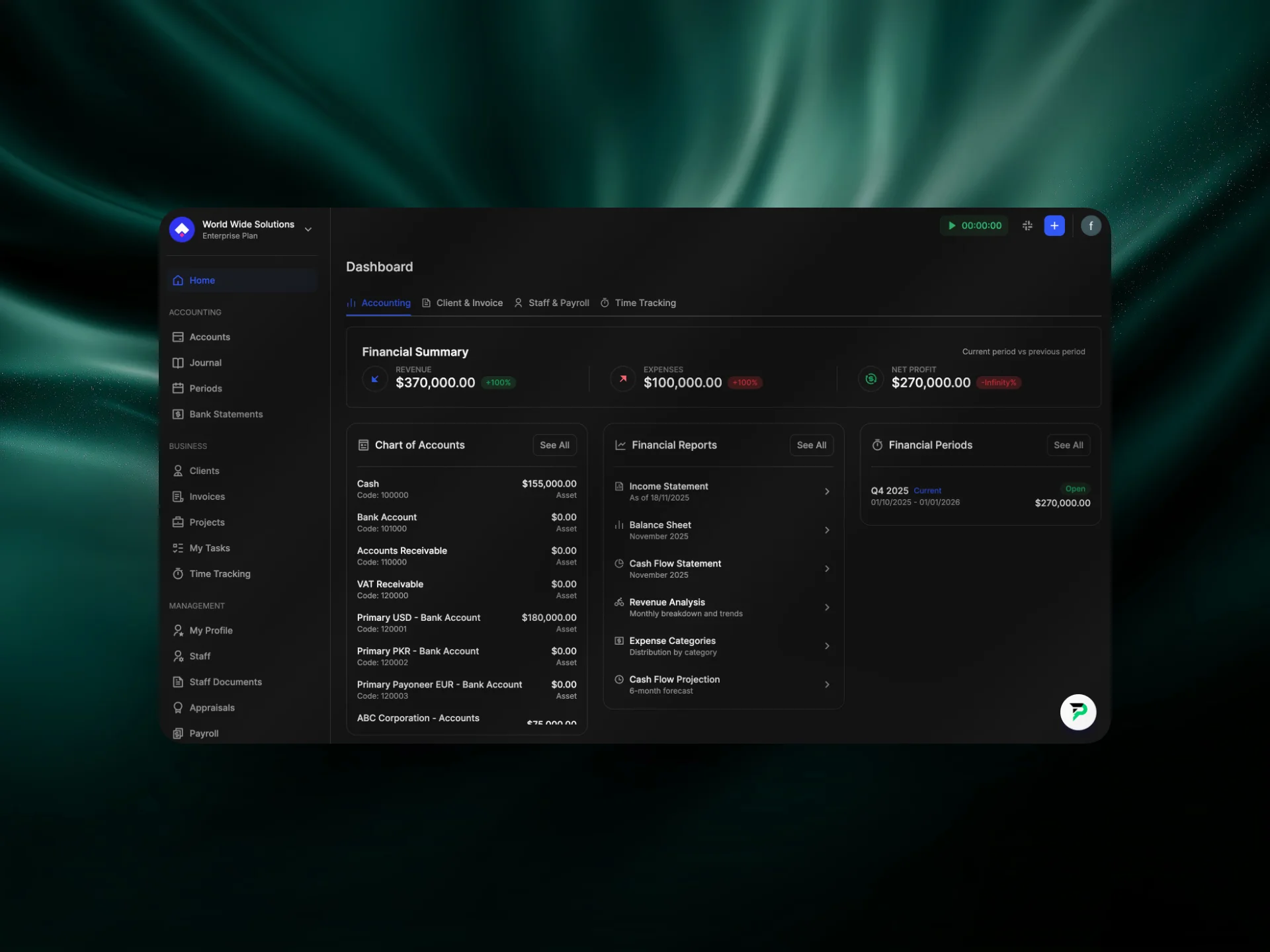
With Halal Accounts, startups can manage:
Accounting and journals
Payroll and appraisals
Staff management
Project management
Time tracking
Invoicing and payments
Reports and statements
This eliminates the need for multiple disconnected software subscriptions.
How Accounting Automation Helps Different Startup Teams
Founders
Get real-time business insights
Track company performance
Reduce operational stress
Make faster decisions
Finance Teams
Automate bookkeeping
Simplify reconciliation
Generate reports instantly
Reduce manual workload
Project Managers
Monitor project profitability
Track billable hours
Improve team productivity
Features Startups Should Look for in Accounting Software
Not all accounting software is built for growing startups.
Here are the most important features to look for:
Automated Invoicing
Generate invoices quickly and automate payment reminders.
Time Tracking
Track employee hours, project timelines, and productivity.
Payroll Management
Handle salaries, tax policies, and staff records in one place.
Project Management
Manage tasks, deadlines, and collaboration efficiently.
Real-Time Reporting
Access financial reports instantly for smarter business decisions.
Cloud Accessibility
Manage your business from anywhere securely.
Scalability
Choose software that grows with your business.
Why Muslim-Owned Startups Prefer Halal-Compliant Solutions
Many Muslim-owned businesses are now seeking ethical and Shariah-conscious financial systems.
Traditional finance tools may not align with Islamic business principles.
Halal Accounts is designed specifically for Muslim-owned businesses looking for a halal-friendly and accounting solution.
The platform combines:
Accounting
Payroll
Projects
Time tracking
Invoicing
Into one integrated system built with productivity and compliance in mind.
This makes it easier for startups to scale while staying aligned with their business values.
Signs Your Startup Needs Accounting Automation
You should consider automation if:
Your team still uses spreadsheets heavily
Invoices are often delayed
Payroll takes too long
You manage multiple disconnected tools
Your startup is scaling rapidly
Manual errors are increasing
The earlier startups automate, the easier future growth becomes.
The Future of Startup Finance Is Automated
In 2026, automation is no longer optional for growing businesses.
Startups that adopt modern accounting systems gain:
Faster operations
Better accuracy
Improved productivity
Scalable workflows
Stronger financial visibility
Accounting automation helps businesses stay organized, profitable, and growth-focused.
Whether you’re managing a small startup team or scaling a larger organization, choosing the right solution can save countless hours and reduce operational headaches.
Final Thoughts
Startup growth brings exciting opportunities — but also financial complexity.
Accounting automation simplifies the process by helping businesses save time, reduce errors, improve cash flow, and scale efficiently.
For Muslim-owned startups looking for an all-in-one halal-friendly platform, Halal Accounts offers a practical solution that combines accounting, payroll, invoicing, and project management into one streamlined system.
As businesses continue embracing automation in 2026, investing in the right accounting software can become one of the smartest decisions for long-term growth.
FAQs
Is accounting automation suitable for small startups?
Yes. Small startups benefit the most because automation reduces manual workload and helps teams operate more efficiently with fewer resources.
Can accounting automation reduce financial mistakes?
Absolutely. Automation minimizes manual data entry errors, duplicate transactions, and reporting inconsistencies.
What industries can use accounting automation?
Almost every industry including SaaS, agencies, eCommerce, consulting, healthcare, and service-based businesses.
Does Halal Accounts support project and payroll management?
Yes. Halal Accounts includes project management, payroll, staff's invoicing, and time tracking features within one platform.

Let’s get started and simplify your administration
Join Halal Accounts to manage your accounts and business better.
Accounting
Staff management
Projects and Tasks
Invoicing and Time Tracking