Next-Generation Accounting Software Trends
In today’s rapidly evolving business landscape, financial management tools are changing faster than ever. Companies are no longer relying on traditional spreadsheets or isolated systems to manage their finances. Instead, organizations are shifting toward smarter, more connected solutions that improve efficiency, accuracy, and strategic decision-making.
One of the biggest developments shaping modern finance systems is the emergence of the Best Accounting Software solutions designed for automation, real-time reporting, and integrated business operations. These next-generation platforms are helping businesses simplify complex financial tasks while improving transparency and control.
Below are some of the most important trends shaping the future of accounting software.
1. Automation Becoming the Core of Financial Operations
Automation is no longer just a helpful feature—it has become a fundamental requirement for modern accounting systems. Businesses want software that can handle repetitive tasks automatically so their teams can focus on strategic work.
Automated accounting systems can now:
Record transactions automatically
Generate invoices and payment reminders
Process payroll with minimal manual input
Reconcile bank statements quickly
By reducing manual data entry, automation significantly lowers the risk of human errors while saving valuable time for finance teams. As companies grow, automated processes also ensure that financial operations remain scalable and consistent.
2. Real-Time Financial Visibility
One of the most powerful capabilities of modern accounting tools is real-time reporting. Instead of waiting for end-of-month financial summaries, businesses can now access live financial data whenever they need it.
Real-time insights help organizations:
Track revenue and expenses instantly
Monitor cash flow continuously
Identify financial issues earlier
Make faster and more informed decisions
With real-time dashboards and interactive reports, finance teams can quickly understand the financial health of their business and adjust strategies accordingly.
3. Cloud-Based Systems Dominating the Market
Cloud technology has transformed the way businesses manage accounting. Instead of installing software on local computers, companies can now access their financial systems from anywhere using secure online platforms.
Cloud accounting offers several advantages:
Remote access for distributed teams
Automatic backups and updates
Improved collaboration between departments
Stronger data security and encryption
For growing organizations, cloud solutions provide the flexibility needed to manage finances across multiple locations and teams without complex infrastructure.
4. Integration With Other Business Functions
Modern accounting software is no longer a standalone tool. Businesses increasingly prefer platforms that integrate accounting with other operational systems.
Integrated financial platforms can connect with:
Payroll systems
Time tracking tools
Project management software
Customer invoicing systems
HR and staff management platforms
This integration creates a unified workflow where data flows seamlessly between departments. As a result, businesses eliminate duplicate work, improve accuracy, and gain a complete view of their operations.
5. AI and Predictive Financial Insights
Artificial intelligence is playing an increasingly important role in accounting technology. AI-driven systems can analyze large volumes of financial data and identify patterns that would be difficult for humans to detect.
Some advanced capabilities include:
Predicting future cash flow trends
Detecting unusual financial activity
Recommending cost-saving opportunities
Automating financial forecasting
These predictive insights allow businesses to move beyond basic bookkeeping and use accounting data as a strategic planning tool.
6. Stronger Compliance and Audit Trails
Regulatory compliance is a major concern for businesses operating in complex financial environments. Next-generation accounting systems help address this challenge through built-in compliance tools and detailed audit trails.
Modern platforms track every financial action within the system, ensuring transparency and accountability. This makes it easier for organizations to prepare for audits, maintain financial integrity, and meet regulatory requirements.
For industries that require strict financial oversight, these features are essential for maintaining trust and operational reliability.
7. Simplified User Experience
As accounting systems become more powerful, usability has become equally important. Businesses want tools that are easy to use for both finance professionals and non-financial team members.
Modern accounting software focuses on:
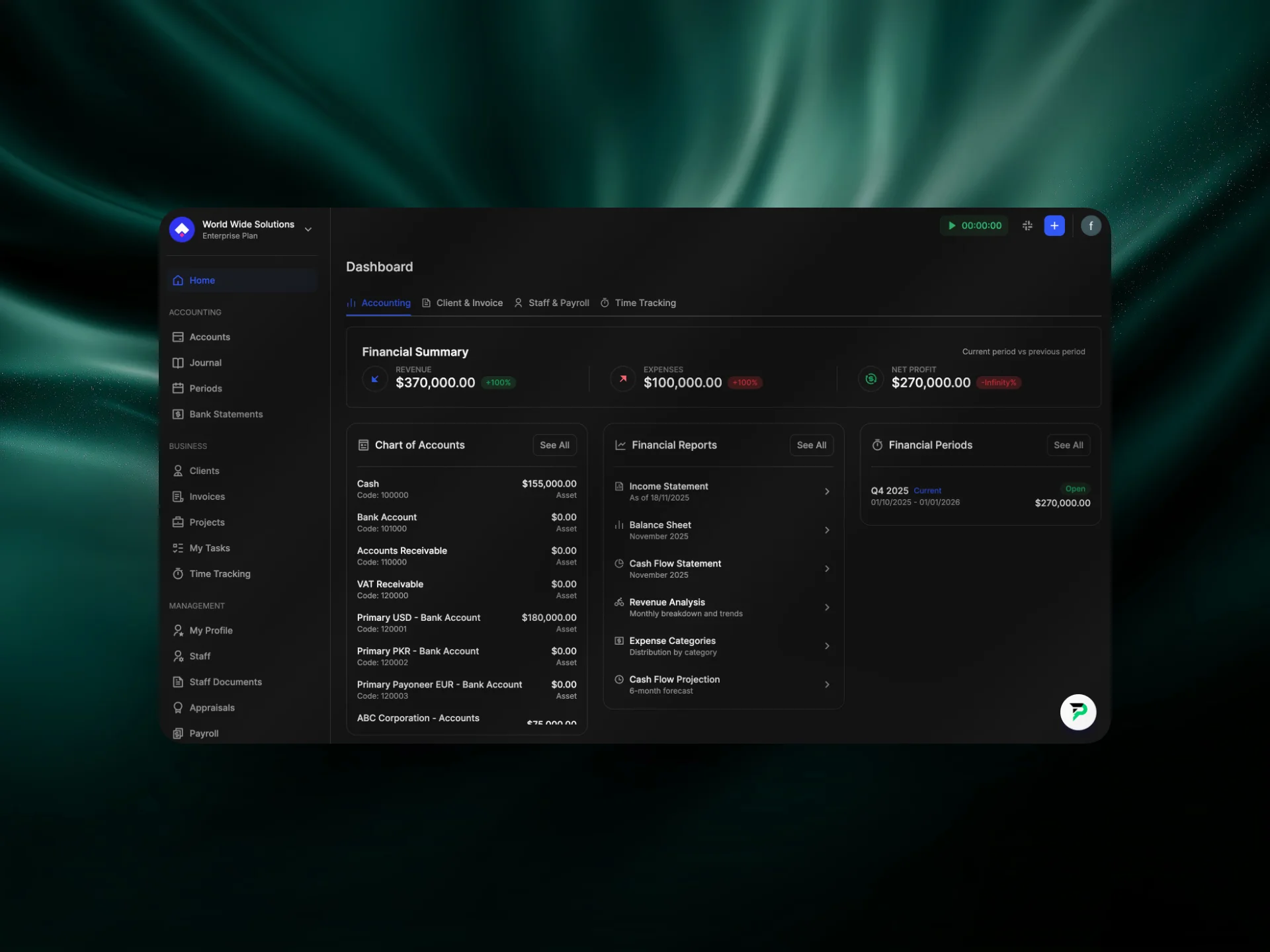
Clean, intuitive dashboards
Simple navigation
Automated workflows
Visual financial reports
A user-friendly interface ensures that employees can manage financial tasks efficiently without extensive training.
The Future of Accounting Software
The evolution of accounting technology is reshaping how businesses manage their finances. Automation, cloud computing, artificial intelligence, and integrated platforms are all contributing to smarter and more efficient financial systems.
As organizations continue to adopt these next-generation tools, accounting will move beyond simple bookkeeping to become a strategic driver of business growth.
For companies looking to simplify financial management while maintaining efficiency and transparency, modern platforms like Halal Accounts provide an all-in-one solution that supports accounting, payroll, project management, invoicing, and staff management within a single integrated system.

Let’s get started and simplify your administration
Join Halal Accounts to manage your accounts and business better.
Accounting
Staff management
Projects and Tasks
Invoicing and Time Tracking